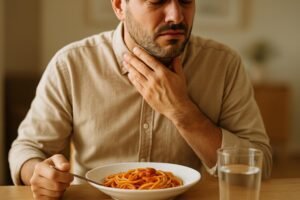
In this insightful discussion, Dr. Greg Livingston explains how Chinese medicine treats reflux, focusing on the concept that two people with the same symptoms can receive very different treatments. With over 30 years of experience, he highlights how Chinese medicine offers a unique perspective on the body’s imbalances.
Introduction and Background
Josef Kreitmayer
Welcome to another amazing session at the Reflux Summit. Today we have an amazing speaker, Dr. Greg Livingston. Dr. Livingston is a Chinese-trained Chinese medicine doctor with over 25 years of experience, specializing in Chinese herbal medicine and internal medicine. He holds a PhD in Chinese herbal medicine from Zhejiang Chinese Medicine University and studied and practiced in China for 12 years. He is experienced in treating a wide range of health conditions in patients of all ages, from newborns to the elderly. He offers in-person consultations in Seattle and Portland, as well as telemedicine globally. Welcome, Dr. Livingston. A pleasure to have you.
Dr. Greg Livingston
Thank you, Josef. Thanks for having me.
Josef Kreitmayer
Could you share a bit about your background and work in Chinese medicine?
Dr. Greg Livingston
Sure. Like you said, I’ve been practicing for over 25 years now. I first did my master’s degree in Chinese medicine in California, graduating in 1997. As soon as I finished school, I went to China because I felt the training in the U.S. wasn’t really adequate. I knew even when I started that I would study in China, but I ended up staying much longer than expected—three years initially, and then another nine years, which is when I completed my PhD.
Chinese medicine has a wide range of treatment modalities. Herbal medicine is arguably the most prominent in China, although acupuncture is more famous in the West. I’m trained and licensed in acupuncture but primarily focus on Chinese herbal medicine. I’ve studied various specialties, including gastroenterology, with a teacher in Hangzhou. I’ve seen many patients with reflux, both during my training and in my practice.
Chinese Medicine Methodology and Reflux
Dr. Greg Livingston
Chinese medicine is a complete and independent medical system. It has its own understanding of physiology, etiology, pathology, and diagnosis. When practicing true Chinese medicine, you must use this methodology. You can study Chinese herbs and apply them based on modern pharmacology, but that isn’t practicing Chinese medicine in its pure form. Chinese medicine is fundamentally a methodology, and the diagnosis using that framework is key.
Reflux, for example, isn’t technically a diagnosis in Chinese medicine. We recognize the symptoms, of course, but the terminology and categorization are different. Ancient Chinese physicians treated what we now call reflux, but they described it using terms like acid regurgitation or stomach pain. Treatment is based on identifying patterns—what we call zhèng.
A key concept in Chinese medicine is same disease, different treatment. Ten people with reflux may each receive a completely different treatment based on their individual Chinese medicine diagnosis. That’s what makes Chinese medicine unique and sometimes effective where other systems fail.
My approach is very methodical. I’m not eclectic; I don’t mix methodologies. I stick closely to what I’ve been taught and follow Chinese medicine principles rigorously. I began studying in 1994, so it’s been 30 years now. I haven’t invented anything—I just apply what I’ve learned. This system is over 2,000 years old and very much tried and true.
Reflux Patterns and Diagnosis in Chinese Medicine
Dr. Greg Livingston
Chinese medicine relies on pattern differentiation, a form of differential diagnosis. Instead of identifying diseases, we identify patterns or syndromes. Someone with reflux might be diagnosed with a pattern like strong stomach, weak spleen.
Ancient texts like the Huangdi Neijing, written 2,500 years ago, provide the basis for understanding. Their language and worldview were different, but they observed the same human phenomena. Heat in the stomach may manifest as burning pain, red cheeks or tongue, and acid regurgitation. We treat that with cooling herbs.
The spleen in Chinese medicine isn’t the anatomical spleen. It’s more aligned with digestive function, overlapping with organs like the pancreas, gallbladder, and intestines. A weak spleen causes inefficient digestion, leading to stagnation and reflux. We use herbs to clear heat and strengthen the spleen.
This concept of heat can loosely align with inflammation in modern terms. Cooling herbs might be considered anti-inflammatory, although it’s not a perfect match. My undergraduate background is in biology, and I’ve spent years trying to correlate Chinese and biomedical views. It’s not easy, but the body is the same—just described differently.
Chinese medicine is holistic. It emphasizes relationships between systems. Western medicine looks at the forest under a microscope, while Chinese medicine views it from the hilltop. Both have strengths. Western medicine excels at detailed, often fast-acting solutions. Chinese medicine provides systemic insight and long-term balance.
Other Common Patterns and Their Roots
Dr. Greg Livingston
Two major patterns I commonly see are strong stomach, weak spleen and wood overacting on earth. The first involves digestive weakness and stomach heat. The second is driven by stress—the liver overacting on the spleen and stomach. Emotional stress impairs digestion.
This also aligns with the sympathetic nervous system. Fight-or-flight suppresses digestion. Chronic stress diverts blood away from the stomach, impairing function and causing upward rebellion of stomach Qi.
Other patterns include cold in the stomach, which causes contraction and reduces blood flow; phlegm and dampness, which represent accumulated fluids; and dryness or yin deficiency, which weakens the mucosal layer and increases vulnerability to reflux.
We gather diagnostic information using the four methods: looking, listening and smelling, asking, and touching. Tongue and pulse diagnosis are especially important. A strong pulse near the radial artery’s styloid process, for example, can indicate reflux. The tongue’s coating gives insight into yin and digestive function.
Herbs, Formulas, and Practice
Dr. Greg Livingston
In classical practice, Chinese herbs are rarely used alone. We use formulas—thousands of which are recorded throughout history. I probably know around a thousand formulas, but I commonly use fewer than one hundred. Some are used almost daily.
Herbs can be plant, animal, or mineral. Roots, bark, seeds, twigs, leaves, flowers, fruits—and historically even insects, shells, and minerals. Some substances used historically are illegal today, and rightly so, but they remain part of the classical record.
Many commonly used formulas come from classical texts written nearly 2,000 years ago. These formulas have stood the test of time. If Chinese medicine didn’t work, it would have been abandoned centuries ago. But it works. It’s practical, results-driven medicine.
Integrating Chinese and Western Medicine
Dr. Greg Livingston
Western and Chinese medicine complement each other well. Western medicine often controls symptoms quickly. Chinese medicine works more deeply to address root causes. Many of my patients are on pharmaceuticals like PPIs. I encourage biomedical assessments because they provide valuable information. Diagnosis and treatment are not the same—biomedical diagnoses can still be treated using Chinese principles.
In some cases, we begin with PPIs to manage symptoms and then introduce herbs to address underlying imbalances. Ideally, medication can be reduced over time. Chinese medicine is not a cure-all, but it has been used to treat the full range of human conditions. Some things can be cured, some improved, and some only partially helped—but there is almost always something we can do.
Treatment takes time. Results depend on age, health, severity, and duration of illness. Improvement may take days, weeks, or months. Most patients have multiple overlapping patterns, so treatment evolves. This requires skill, ongoing assessment, and patience.
Closing Thoughts
Dr. Greg Livingston
Patterns often overlap. It’s common to see multiple imbalances in one person. We think of these as layers—superficial and deep—and prioritize treatment accordingly. The key is to treat logically and systematically, adapting as the condition changes. Chinese medicine offers that flexibility, grounded in centuries of clinical experience.