TL;DR:
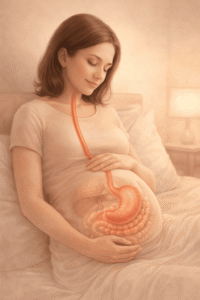
Physical Pressure: Excess abdominal fat increases intra-abdominal pressure, forcing the lower esophageal sphincter (LES) open and promoting hiatal hernias.
Chemical & Hormonal Drivers: Visceral fat releases inflammatory cytokines that damage the esophagus and disrupts leptin signaling, which slows digestion and weakens the LES.
Nervous System Link: Low-grade inflammation impairs the vagus nerve, slowing gastric emptying and reducing sphincter control.
Root-Cause Solution: Acid suppressants only mask symptoms; long-term relief requires addressing the underlying pressure through weight loss, smaller meals, microbiome support, and diaphragmatic breathing.
There’s a moment many people with chronic reflux recognize: the burning returns after a meal, the throat tightens, sleep becomes fragmented, and antacids stop working the way they used to. What most people don’t realize is that the weight carried around the midsection may be doing far more damage than any single food ever could.
The relationship between obesity and GERD is one of the most underexplored conversations in reflux management. It’s not simply about eating too much or lying down after dinner. The mechanisms run deeper, touching pressure dynamics, hormone signaling, inflammatory chemistry, and even how the nervous system regulates the digestive valve responsible for keeping acid where it belongs.
Understanding why excess abdominal fat amplifies reflux, and what can actually be done about it, is one of the most empowering pieces of knowledge anyone managing chronic GERD can have.
How Abdominal Fat Drives Acid Upward
The stomach sits in a pressure environment. Under normal circumstances, the chest maintains negative pressure while the abdomen holds positive pressure. This gradient is actually part of what keeps digestion moving in the right direction.
When excess fat accumulates in the abdominal region, that gradient shifts dramatically. Intra-abdominal pressure rises, and the stomach is essentially squeezed from the outside. The result is a stronger upward push against the lower esophageal sphincter, the muscular valve that separates the stomach from the esophagus.
Research has shown that gaining as few as 3.5 BMI units can triple the risk of developing reflux symptoms. Waist circumference, more than BMI alone, is strongly correlated with elevated gastric pressure, which means the distribution of fat matters as much as the total amount.
After eating, this elevated pressure activates stretch receptors in the stomach wall. Those receptors trigger what are called transient lower esophageal sphincter relaxations, or TLESRs. These are involuntary, brief openings of the valve that allow acid to escape upward. In people with obesity, TLESR episodes occur at a rate of approximately 17.3 per hour, compared to 2.1 per hour in individuals at a healthy weight. And in those with higher BMI, 63.5% of those episodes result in acid reflux, versus 17.6% in non-obese controls.
This is not a willpower issue. It is a physics and physiology issue.
The Lower Esophageal Sphincter and Why Obesity Weakens It
The lower esophageal sphincter, or LES, is the gatekeeper of the digestive tract. When it functions properly, it stays contracted between meals, preventing stomach contents from traveling upward. When it loses tone, acid reflux becomes almost inevitable.
Obesity weakens the LES through several overlapping pathways. First, chronic exposure to high intra-abdominal pressure mechanically disrupts sphincter function over time. Second, diets high in fat, commonly seen in patterns associated with weight gain, stimulate the release of cholecystokinin, a hormone that directly encourages LES relaxation.
Up to 25.6% of patients with morbid obesity show abnormal esophageal manometry results, including a weak LES, even when they report no symptoms. This silent dysfunction matters because undetected reflux exposure can still damage the esophageal lining and, over time, drive more serious complications.
Hiatal Hernia: When Pressure Creates Structural Change
Sustained high abdominal pressure does not just affect sphincter tone. It can physically displace the stomach. A hiatal hernia occurs when part of the stomach pushes upward through the diaphragm into the chest cavity. Among people with obesity, this structural change affects between 40% and 50% of patients.
When a hiatal hernia develops, both the internal and external antireflux barriers are compromised simultaneously. The LES loses structural support, the diaphragmatic crural sphincter is disrupted, and the angle at which the esophagus meets the stomach, known as the Angle of His, becomes flatter, further reducing the natural mechanical barrier against reflux.
Non-surgical management of hiatal hernia increasingly includes diaphragmatic strengthening, specific breathing protocols, and devices like the IQoro, which target the musculature involved in esophageal function. These approaches recognize that structural correction is possible without surgery in many cases, particularly when caught early and combined with meaningful lifestyle change.
Hormones, Inflammation, and the Metabolic Side of Reflux
This is where the conversation about obesity and GERD becomes particularly important for integrative and holistic practitioners. The connection is not purely mechanical.
Visceral fat, the deep abdominal fat that surrounds internal organs, behaves like an endocrine organ. It actively releases adipokines, inflammatory cytokines, and other signaling molecules that circulate through the body and affect the esophageal lining directly. These inflammatory markers can damage the mucosal barrier of the esophagus even in the absence of significant acid exposure.
Leptin, a hormone produced by fat tissue, plays a dual role. In healthy physiology, leptin helps regulate gastric emptying and LES tone through its interaction with the vagus nerve and cholecystokinin receptors. In obesity, however, leptin resistance develops, disrupting these interactions and impairing both gastric motility and sphincter control. Fat-rich diets slow gastric emptying further, increasing the volume and pressure of stomach contents and extending acid exposure time.
The result is a hormonal environment that actively undermines the body’s ability to regulate reflux, independent of what is eaten at any individual meal.
According to research published in the journal Gastroenterology, visceral adipose tissue may independently predispose individuals to complications like Barrett’s esophagus and esophageal adenocarcinoma through these metabolic and inflammatory pathways, not just through mechanical reflux alone.
The Gut-Brain Axis and Nervous System Regulation in Reflux
One dimension often missing from the obesity-GERD conversation is the role of the nervous system. The vagus nerve is the primary communication pathway between the gut and the brain. It regulates gastric motility, LES tone, gastric acid secretion, and the body’s inflammatory response.
Chronic stress, poor sleep, and dysregulated breathing patterns all impair vagal tone. When vagal tone is low, the digestive system shifts toward a more reactive, less coordinated state. Gastric emptying slows, sphincter control becomes less precise, and the gut becomes more vulnerable to inflammatory signals from visceral fat.
In obesity, this cycle is often compounded. Visceral fat contributes to systemic low-grade inflammation. Inflammation impairs vagal signaling. Impaired vagal signaling worsens digestion. Poor digestion increases reflux frequency. And reflux symptoms drive stress and disrupted sleep, which further suppress vagal tone.
Diaphragmatic breathing, practiced consistently and correctly, is one of the most evidence-supported tools for improving LES function and vagal tone simultaneously. A study found that diaphragmatic breathing exercises significantly reduced acid exposure time and belching frequency in GERD patients.
This is not an alternative approach. It is physiology-based therapy with measurable outcomes.
Dietary Patterns That Compound Reflux in Obesity
High-fat diets deserve particular attention in the context of obesity and reflux. Fat slows gastric emptying significantly. When the stomach empties slowly, acid production continues, volume increases, and pressure builds. This is the physiological reason fatty meals trigger reflux so reliably.
Beyond the fat content itself, portion sizes matter mechanically. Large meals distend the stomach, activating those same stretch receptors that trigger TLESR episodes. For someone already carrying excess abdominal fat, a large high-fat meal is essentially double-loading an already stressed reflux system.
Practical shifts that support both weight management and reflux reduction include eating smaller, more frequent meals, reducing dietary fat without dramatic restriction, avoiding eating within two to three hours of lying down, and identifying individual food sensitivities that may be compounding inflammation.
Food sensitivities and histamine intolerance, both increasingly recognized in the reflux community, can be exacerbated by gut permeability issues that are themselves worsened by visceral fat-driven inflammation. Addressing the microbiome and gut lining integrity is part of a comprehensive approach to healing reflux in the context of obesity.
What the Research Says About Weight Loss and Reflux Improvement
Weight loss is among the most consistently supported interventions for reducing GERD symptoms. Research published demonstrated that even modest intentional weight loss significantly reduced reflux episodes and symptom frequency.
For individuals with severe obesity, bariatric procedures such as Roux-en-Y Gastric Bypass have shown resolution of GERD symptoms in up to 94% of cases, along with regression of Barrett’s esophagus in approximately 40% of patients. Sleeve gastrectomy, by contrast, has been associated with worsening reflux in some individuals due to increased gastric pressure and altered anatomy, which highlights the importance of individualized assessment.
For those not pursuing surgical pathways, evidence supports a combination of gradual intentional weight reduction, dietary restructuring, nervous system regulation practices, and consistent movement as an integrated strategy for meaningful long-term reflux improvement.
A Root-Cause Framework for Managing GERD in Obesity
Managing reflux in the context of obesity requires moving beyond symptom suppression. Proton pump inhibitors address acid production but do not resolve abdominal pressure, LES weakness, hiatal hernia, hormonal disruption, or vagal dysregulation. Long-term PPI use carries its own risks, including impacts on gut microbiome diversity, magnesium absorption, and bone density.
A root-cause framework looks at reflux through multiple lenses simultaneously. This addresses mechanical factors through weight management and diaphragmatic strengthening. It addresses metabolic factors through dietary restructuring and gut support protocols. It addresses the nervous system through vagal tone work, breathwork, and stress physiology. And it addresses gut integrity through microbiome support and identification of inflammatory triggers.
A systematic review published confirmed the bidirectional relationship between obesity and GERD, reinforcing the need for integrated treatment approaches rather than isolated symptom management.
This kind of thinking, functional, root-cause, nervous-system-aware, is precisely what is missing from mainstream reflux care.
Healing Is Not Linear, But It Is Possible
Living with reflux that is amplified by excess abdominal weight can feel defeating. Symptoms are daily, medications feel like the only option, and the connection between the two conditions often goes unaddressed by standard care.
But the pathways that create this problem are also pathways that respond to intentional change. Abdominal pressure decreases with meaningful weight loss. LES tone improves with diaphragmatic strengthening. Vagal tone improves with consistent nervous system regulation. Inflammation decreases as visceral fat reduces and diet shifts. Each of these changes supports the others.
Progress is measured in weeks and months, not days. But the research is clear: addressing the root causes of reflux in obesity produces real, lasting improvement.
Take the Next Step Toward Lasting Reflux Relief
For anyone navigating the complexity of reflux, weight, and whole-body digestive health, finding trustworthy, evidence-based guidance matters enormously.
The Reflux Summit brings together leading experts across gastroenterology, integrative medicine, nutrition, and lifestyle medicine to share the most current, multi-disciplinary insights on reflux healing. The summit covers root-cause frameworks, non-medical management strategies, gut-brain connection, dietary approaches, and evidence-based lifestyle interventions, all in an accessible, educational format designed for people ready to move beyond symptom management.
Sign up below to access expert interviews, practical healing frameworks, and a community dedicated to long-term reflux resolution.